
Accounting in the Ancient World

An image of Mesopotamian accounting tokens.
Accounting is one of the most underappreciated developments in human history. It does not hold the civil prestige of writing, nor does it possess the obvious physical presence of the wheel and plow. Yet it is likely that without early accounting systems, civilization as we know it would not have developed. Long before bank statements and corporate ledgers, ancient societies were already figuring out the basics of finance: how to keep track of what you have, what you have given, and what you still owe.
The origins of accounting can be traced to ancient Mesopotamia, a region centered in present-day Iraq. This area is often referred to as the “Cradle of Civilization” because it was home to our earliest cities: Uruk, Ur, and Eridu. Mesopotamia’s uniquely rich soil and freshwater reservoirs provided the foundation for the expansion of agriculture, and subsequently, a rapid increase in population. As a result, administrative priests faced a challenge unfamiliar to smaller communities: keeping track of an extensive quantity of resources. Grain was stored in warehouses, livestock was transported across cities, and large groups of people made up labor organizations. In order to maintain control over these systems, administrators requested the help of scribes to develop an early form of recordkeeping that functioned as accounting, one that predated their writing system.
The earliest system (c. 8000 BCE) relied on the creation and distribution of small clay tokens. Different shapes represented different goods – spheres and flat disks translated to barley, ovoids to jars of oil, cylinders to domesticated animals, and tetrahedrons to labor, respectively. As cities like Uruk grew, the tokens became more intricate, marked with dots, lines, and even being shaped into goods and animals. While largely simplistic in design, this token system allowed early cities to maintain an effective level of economic coordination.
However, as Mesopotamia’s civilization advanced, this system became anachronistic, breaking down under the complexity of an ever-changing society. While physical tokens served their initial purpose, they could easily be stolen or lost. To prevent tampering, administrators placed the tokens in hollowed clay envelopes, bullae, after pressing them onto the exterior for an accurate record of the contents inside. In 3100 BCE, a century later, scribes realized that the token impressions themselves were a more efficient method of record-keeping. Thus, the tokens were phased out and inscription on clay tablets became the primary method of accounting. These marks gradually evolved into cuneiform, the earliest known writing system.
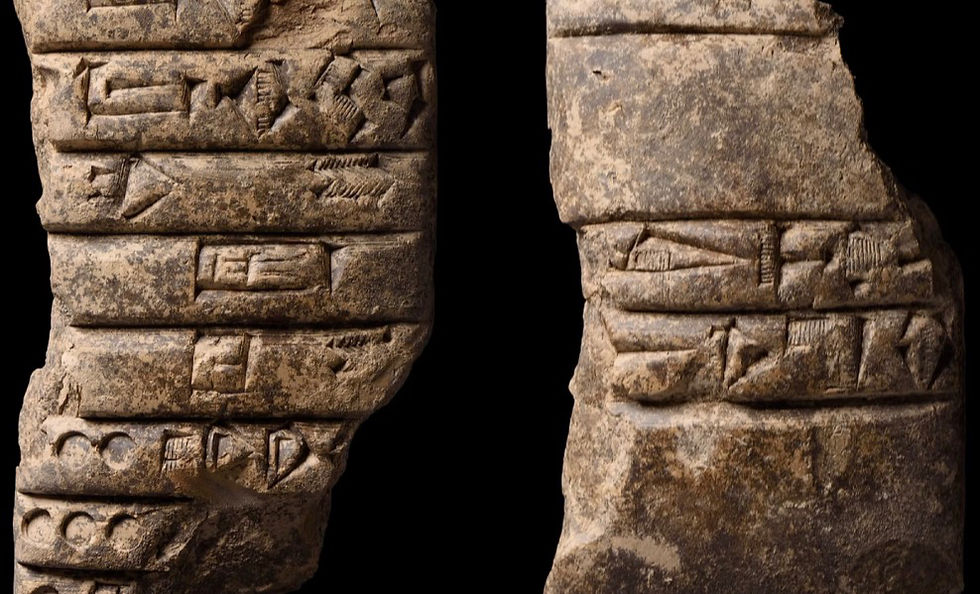
An ancient Sumerian clay tablet, featuring the name of an Akkadian governor.
Writing did not begin with stories of winged beasts, religious texts, or the musings of philosophers. Rather, the earliest surviving texts are inventories of agriculture, records of livestock, and receipts of goods exchanged. Writing in its earliest form could be considered mundane, but it was essential to the survival of civilizations nonetheless.
Scribes, as the keepers of this new craft, were also essential to maintaining the stability of cities. They held specialized positions within Mesopotamian society, trained extensively in numerical systems and standardized signs. Their role was functional and highly respected. A king could not collect taxes if he could not count. He could not distribute food without knowing what was stored. He could not organize labor without records of who had to fulfill their corvée labor (a mandated public work obligation) and when. Effectively ruling an expanding civilization would have been nearly impossible without reliable recordkeeping systems.
Accounting systems were not confined to the geographical boundaries of Mesopotamia. In ancient Egypt, taxes were an enormous factor in the functioning of its monarchy. During an event known as the Egyptian Cattle Count, the king and his advisors would travel, assess the value of farmers’ crops, and collect a certain amount in taxes. Subjects of ancient Egypt paid their “taxes” through a barter system, as coinage was not introduced until the 6th and 5th centuries BCE. While farmers paid their taxes through exporting their grain, non-farmer citizens fulfilled their tax obligations through labor. Their labor sustained the economy, built some of the longest-standing historical structures, and maintained, in their eyes, cosmic order and balance. Taxes were so intertwined with Egyptian culture that citizens believed they would be required to pay them in the afterlife as well. Small figurines called ushabti were placed in graves, “inscribed with spells ensuring [they] would perform their deceased owner’s labor taxes when called upon,” according to Archaeology Magazine.
Centuries later, the Roman Empire operated on a far larger scale but depended on the same basic accounting principles. Though unlike Mesopotamia, Rome relied on recordkeeping to maintain its bureaucracy rather than agricultural production. Censuses were conducted to determine population size, military expenditures were tracked, and treasury accounts were documented to prevent embezzlement. Although many original records have been lost to fires, time, and sacking, historical references and inscriptions provide evidence of Rome’s administrative sophistication. This complexity is what allowed Rome to prosper for so long, and if it had not, global history would be completely unrecognizable.

One aureus, a monetary unit of Ancient Rome.
One of the most significant developments in history came much later, during the Renaissance. In 1494, Italian mathematician Luca Pacioli published a formal description of double-entry bookkeeping in Summa de Arithmetica. Through his system, Pacioli recorded every transaction in two categories, debit and credit, effectively laying the foundation for global commerce to evolve over the next several centuries.
Although accounting has long evolved since the days of clay tablets, its fundamental purpose remains unchanged. Governments use accounting systems to allocate resources and monitor economic activity. Businesses depend on financial records to make strategic decisions. Individuals utilize accounting techniques when managing budgets, paying taxes, and planning for retirement. Many of the developments we have today can be owed to ancient solutions for problems withstanding the evolution of humanity. So the next time you’re tempted to complain about filing taxes, think of it this way: your abilities would have once landed you a prestigious position in a Mesopotamian temple.


