
Dark Pools: The Hidden Markets Behind Wall Street Trades
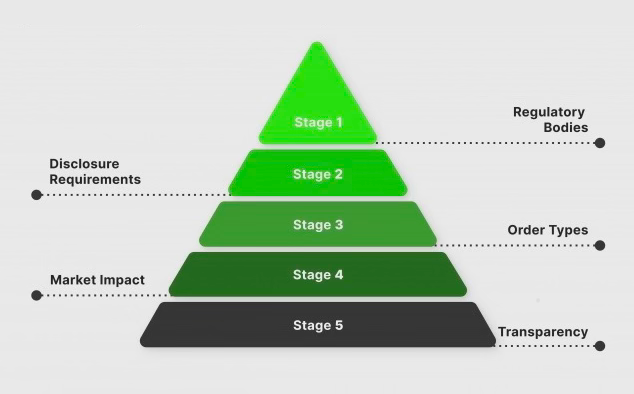
A pyramid visualizing the regulatory landscape of dark pool trading (via b2broker.com).
When thinking about trading, most people imagine stocks being transferred on large public exchanges where prices and transactions are visible to everyone. When a share is bought or sold, the trade should appear in market data that investors all around the world can see at a moment’s notice. But a significant portion of modern financial trading happens outside these public exchanges and rather in private venues that only a few can access, commonly known as dark pools. These markets operate behind the scenes, and are used by investors to trade large quantities of stocks without letting the public know.
Dark pools were created to solve a problem by major venture capital funds and large investors. When organizations like pension funds, mutual funds, or hedge funds wish to buy or sell millions of a stock, placing an order on a public exchange can move the market price tremendously. Other day to day traders and smaller funds can detect the large order and react before the trade is completed, letting prices go up or down in ways that can hurt the initial investor that placed the order. Dark pools let these institutions make these trades discreetly, dramatically reducing the market impact on these transactions.
How Dark Pools Work
Dark pools are run by banks, brokerage firms, or independent financial companies; a requirement of the darkpool to work is they have to be private trading venues. This means that they do not publicly display their order books. Traders inside a dark pool make buy and sell orders that remain hidden until a trade is fully completed. Only after the transaction occurs, it is reported to the market, making any changes after not affecting the original user of the dark pool.
This system lets large investors break up trades into smaller pieces and execute them locking in their order price without explicitly showing the full size of their orders. To put this in perspective, if a pension fund wants to sell a million shares of a company, they wouldn’t be able to just sell it on the spot, because it would cause immense panic with investors, which can push the price downward even before the sale is finished. Now in a dark pool, the fund can match the sellers with the buyers without alarming the market.
Today, almost all major financial institutions have and utilize their own dark pools. Common examples are the megabanks Goldman Sachs and Morgan Stanley. They run private trading venues that handle billions of dollars in transactions daily.
Why Institutions Use Them
Dark pools have several advantages for institutional investors. The most important one is protection from market impact. Large trades can trigger automated algorithms that can react at a moment’s notice to price movements. These algorithms can exploit these visible orders by making immediate profit by buying ahead of large purchases or selling ahead of large sales or shorting the order. By hiding the orders, dark pools can reduce the risk of these strategies affecting their order.
Another benefit of dark pools is improved price stability. Because the trades occur privately until the order is sent to the market, other people wouldn’t be able to react while the order is still processing. This lets institutions complete large transactions much closer to the intended price they wanted to complete the trade.
Dark pools can also limit the transaction costs. When large investors avoid price swings that were caused by their own trades, they can usually get better average prices. Although it may only be in the cents, a large market transaction can mean that they would be saving a lot of money for funds that manage orders worth billions of dollars.
Criticism and Controversy
Even though darkpools can help many, they have been controversial since the start of them being made. Critics argue that if significant amounts of trades occur outside public exchanges, it can undermine market transparency. Public markets rely on open information so that prices can reflect the collective knowledge of all traders. When such a big portion of trading happens in private venues, price discovery can become less accurate and hurt the other traders.
There are also concerns about fairness. Some dark pools have been accused of giving some traders preferential access or letting them use strategies that can exploit slower investors. Regulators have investigated and sometimes found proof of firms failing to disclose how their dark pools operated and possible legal issues.
Regulatory agencies like the U.S. Securities and Exchange Commission monitor dark pools very closely and require them to report activity. But because these venues are privately owned, ensuring transparency is still difficult. Balancing the need for large investors to trade efficiently with the need for open markets continues to be a major challenge.
A Hidden but Powerful Market
Although dark pools operate outside the public spotlight, they still handle a substantial share of global equity trading. Depending on the market, the transactions on dark pools can reach up to a third of all transactions instead of using traditional exchanges. This means that many of the trades are not in a place that the average investor will ever see.
Supporters argue that dark pools can reduce unnecessary volatility, but at the same time critics say that too much secrecy can weaken confidence in the fairness of the system.
Conclusion
Dark pools represent one of the most intriguing developments in modern finance. By allowing large institutions to trade privately, they solve practical problems that public markets struggle to address. At the same time, their hidden nature raises important questions about transparency, fairness, and the structure of global financial systems.
For everyday investors, the existence of dark pools serves as a reminder that financial markets are far more complex than the visible charts and prices on a trading screen. Beneath the surface lies an intricate network of private exchanges and algorithmic systems quietly shaping the movement of billions of dollars every day.


