
The Great Rise And Fall Of The Roman Empire
Updated: Sep 1, 2025
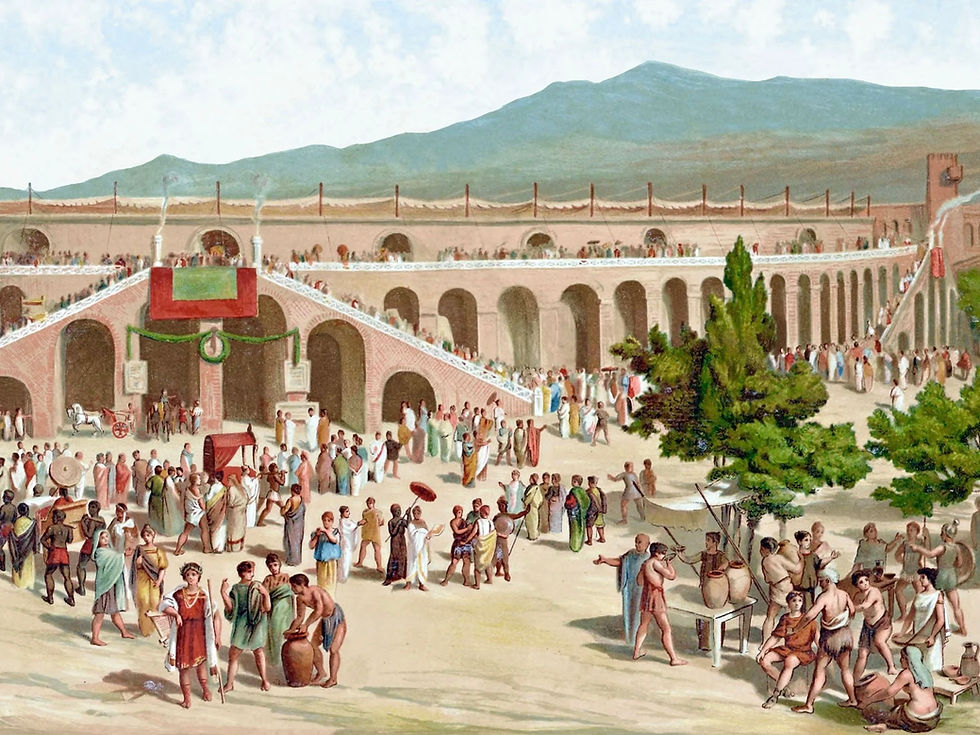
An artistic depiction of daily life in the Roman Empire.
The Roman Empire is arguably one of the greatest and most influential empires in all of human history. Since its start as a small city on the Italian Peninsula, the Roman Empire grew into a strong civilization that influenced law, politics, and culture across much of Europe, North Africa, and the Middle East. When the empire was at its height, it was known as home to millions of people and spanned parts of three continents. Even though it had racked up many significant accomplishments during its existence, it eventually fell, just like many of the great powers in history. Though the empire itself is no more, it still left a legacy that has shaped and will continue to shape our world.
The Birth of Rome
According to legend, the city of Rome was founded by the twin brothers Romulus and Remus in 753 BCE. This story has been highly debated among historians, as it is not verified and is largely just based on popular belief. However, if there is one thing that historians agree upon, it is that Rome initially started as a settlement along the Tiber River.
During the Roman Republic period, which lasted from 509 BCE to 27 BCE, citizens elected representatives to govern them. This political structure greatly helped Rome expand its influence to more areas of the world. By 146 BCE, Rome had defeated Carthage in the Punic Wars, which allowed it to gain control over much of the land surrounding the Mediterranean Sea.
The Roman Empire Emerges

A map of the Roman Empire at its territorial height in 117 CE.
The transition from Republic to Empire can mainly be attributed to Julius Caesar. His exemplary leadership and military victories brought him major popularity, but his growing power alarmed the Senate. In 44 BCE, Caesar was assassinated, which put the entirety of the Roman Republic into chaos and confusion about who had leadership. After some time, his adopted heir, Octavian, also called Augustus, defeated his rivals and became the first Roman emperor in 27 BCE, officially marking the beginning of the Roman Empire.
Under Augustus’ rule, Rome entered a period known as the Pax Romana, which stands for “Roman Peace,” and it lasted for about 200 years. During this time, the empire saw many achievements in architecture, engineering, literature, and governance. Roads, aqueducts, and monumental buildings such as the Colosseum were constructed, many of which still stand today, though not as magnificent as they may have once been. These advancements were due to this prolonged period of peace, and it allowed for uninterrupted development in the empire.
Life in the Roman Empire
Life in Rome varied depending on social class. The wealthy lived in villas and had more entertainment opportunities, while the poor and middle-class Romans lived in crowded apartments or housing complexes, relying heavily on public entertainment for leisure. Despite these divisions in status and social class, Roman law created an order that united the large and diverse empire.
Trade was done very smoothly in the Roman Empire, as it connected faraway provinces through an extensive network of roads and sea routes. Latin, the Roman language, became the foundation of many modern languages, including Spanish, French, and Italian. Even though English is not a Romance language that directly descended from Latin, estimates suggest that up to 60% of English words have Latin origins.
The Fall of the Empire

Thomas Cole’s painting Destruction (1836) showing the fall of a great empire, likely inspired by the Roman Empire.
While the Roman Empire was very powerful, it still had problems, and multiple factors contributed to its eventual decline. Economic troubles over decades weakened the empire, as heavy taxation and inflation hurt trade and productivity. Adding on, political instability, often in the form of violence, led to excessive changes in leadership. Given the empire’s size, it was hard to maintain control of the outer areas, as barbarian tribes, such as the Visigoths and Vandals, posed military challenges and invaded Roman territories, causing heavy losses.
In 476 CE, the Western Roman Empire officially fell when the Germanic leader Odoacer removed the last Roman emperor, Romulus Augustulus, from office. However, the Eastern Roman Empire, also known as the Byzantine Empire, continued to survive for nearly another thousand years.
The Legacy of the Roman Empire
Since the Western Roman Empire fell in 476 CE and the Eastern Roman (Byzantine) Empire fell in 1453 CE, we can’t just pin the fall of the Roman Empire to one of these years. However, most side with 476 CE behind the end of the Roman Empire because although the Eastern Roman Empire was a continuation of the original Roman Empire, it was distinct in several key ways, including culture.
The Roman Empire and its later continuation as the Byzantine Empire significantly influenced the modern world. Roman ideas about government, law, engineering, culture, and language shaped medieval Europe, the Renaissance period, and the colonial era. In fact, they still have influence and have left their marks on present-day society. From modern legal systems to some of the most complex architectural designs, traces of the Roman Empire can be found in our daily lives in some shape or form.
Conclusion
The story of the Roman Empire is one of ambition, innovation, and resilience. It rose from a small city and went on to dominate much of Europe, Africa, and Asia. The empire may have collapsed, but its legacy continues in our world, reminding us that history is not just about the past, but it is the foundation upon which we build our present and future.


