The Taiping Rebellion: A Forgotten Civil War That Nearly Remade China
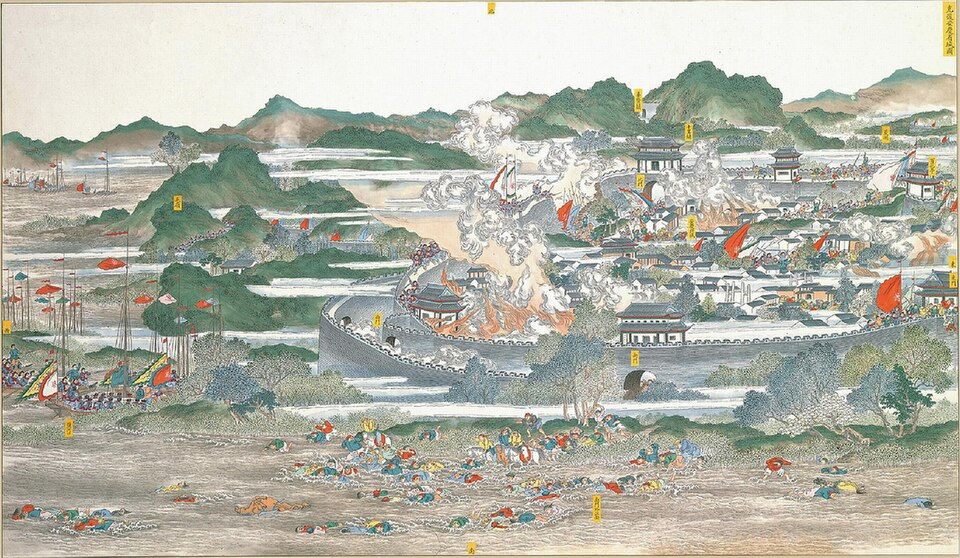
A painting depicting the Battle of Anqing in 1861.
When people are referring to the deadliest conflicts in history, they usually think about the World Wars or maybe even the American Civil War. However, this is ignoring one of the most devastating wars in history, and while it may be less well-known among academic circles, it remains just as significant of many other major wars: the Taiping Rebellion. This civil war took place in 19th-century China and had a direct result of 20 to 30 million deaths, making it easily one of the worst conflicts in human history. Although its scale is tremendous, it’s not very discussed in general history classes outside of East Asian studies, making it a very unknown topic.
The Taiping Rebellion wasn’t just a revolt against the ruling dynasty, the Qings. Rather, it was a radical political, social, and religious movement that almost overthrew one of the most powerful empires in the world. At its center, there was an unlikely leader whose beliefs and ambitions completely transformed local unrest into a major-scale conflict that single-handedly reshaped Chinese history.
The Rise of Hong Xiuquan
The rebellion started with Hong Xiuquan, a seemingly common man from southern China who failed the imperial civil service examinations more than once. The reason this exam was so important was that it provided the main route to government power and social advancement, and failure could mean disappointment from your family. After one of these failures, Hong experienced a series of intense visions and religious revelations. After encountering Christian missionary writings, Hong started to believe that his visions meant that he was the brother of Jesus Christ, sent to purify China and overthrow corruption. This belief system combined Christian ideals with Hong’s own interpretations and thoughts, and also anti-Qing political goals.
He was able to attract many followers, especially among populations that were in poverty, disliked local corruption, were part of ethnic tensions, or faced economic hardship. What started as a religious movement changed quickly into a revolutionary force that was known by commoners as the Taiping Heavenly Kingdom.
A Revolutionary New State
The Taiping movement was unique for several reasons. The differentiating factor wasn’t because of its religious foundation but because of its ambitious political vision. After capturing territory, the rebels made their capital in Nanjing, calling it Tianjing, or the “Heavenly Capital.”
The new government introduced many radical reforms during this time period. It introduced land distribution plans to reduce wealth inequality, making private property harder to establish, and strict moral codes. Although men and women were still segregated in daily life, women were granted roles in society, such as serving in the military. This was very uncommon in the 19th century.
This combination of religious zeal, social reform, and military expansion made the Taiping state fundamentally different from the Qing government it sought to replace.
One of History’s Deadliest Conflicts

A map of the Qing dynasty around 1820.
The war between the Taiping forces and the Qing dynasty became a devastating civil conflict, with numerous provinces destroyed and ravaged. Control of cities changed many times, and due to the civil war, famine, disease, and displacement also increased significantly.
What makes this rebellion so important isn’t just the number of casualties but the scale of destruction of China's economy. Productive farmland was ruined, trade networks were weakened, and millions of people had to flee their hometowns.
The Qing dynasty, although initially weakened because of the loss of money, was able to reorganize and create regional armies led by powerful local officials. Because of the creation of these regional armies, it was much easier to defeat the rebellion, but it still had lasting effects because political power moved away from the central imperial government into local armies. By 1864, Qing forces recaptured Nanjing, and the rebellion was completely crushed. Hong Xiuquan died shortly before the city fell, reportedly from illness and starvation.
Why It Matters
The Taiping Rebellion is a niche historical topic, but its importance is immense. First, it severely weakened the Qing dynasty, leaving it vulnerable to internal unrest and foreign pressure for decades afterward. Many historians view the rebellion as one of the major events that contributed to the eventual collapse of imperial China in the early twentieth century.
Second, it transformed the balance of political power. Because the Qing relied heavily on regional armies, local military leaders gained influence that later shaped modern Chinese politics.
Third, the rebellion provides insight into how religion, social inequality, and political instability can combine into revolutionary movements. Its ideology was unlike most other rebellions of the period, blending imported religious concepts with local grievances and nationalist sentiment.
Conclusion
The Taiping Rebellion is one of the most overlooked events in world history. Led by a man who believed he had a divine mission, it became one of the deadliest civil wars ever recorded in history. Though often absent from mainstream history discussions, it remains a powerful example of how ideology, inequality, and political crisis can combine to reshape an entire civilization. Its scale, uniqueness, and lasting effects make it one of the most compelling niche topics in history.